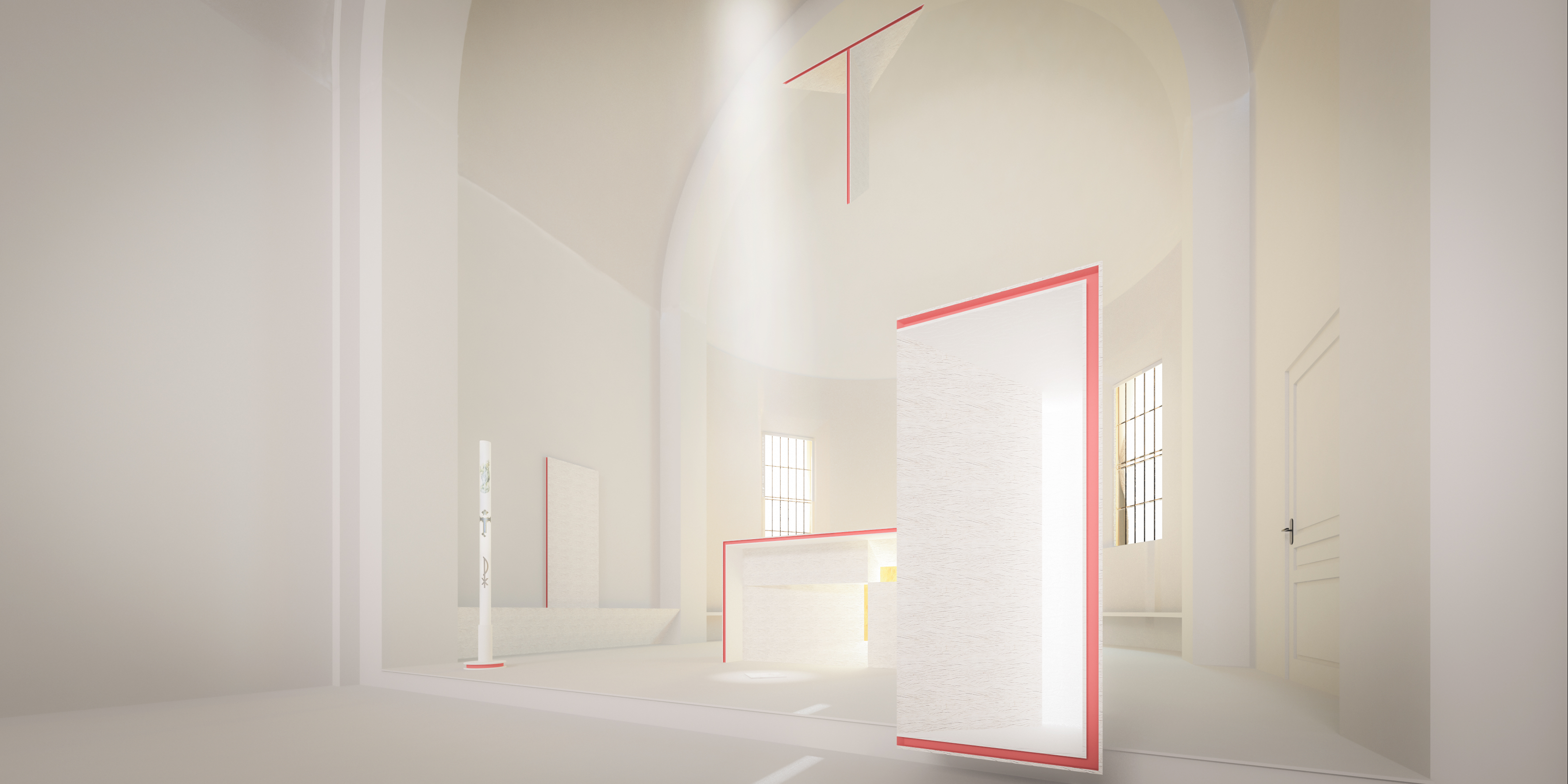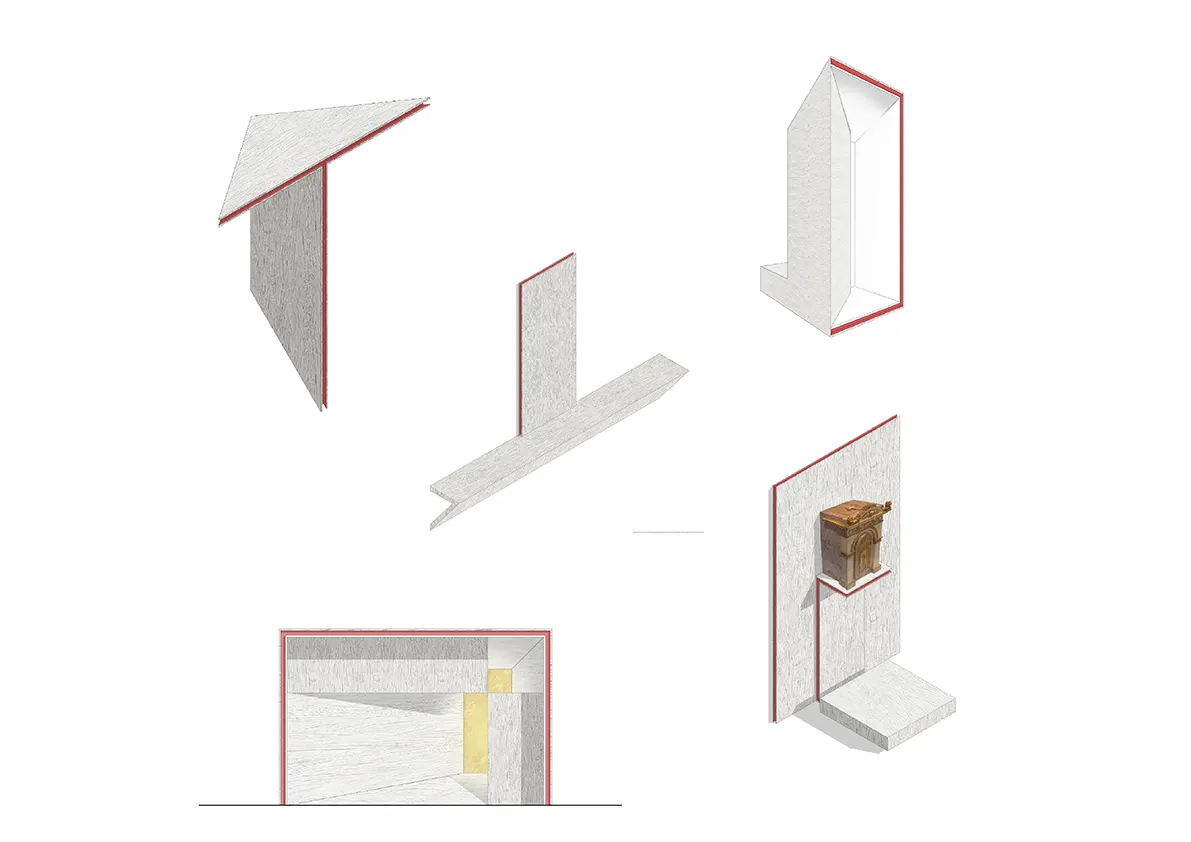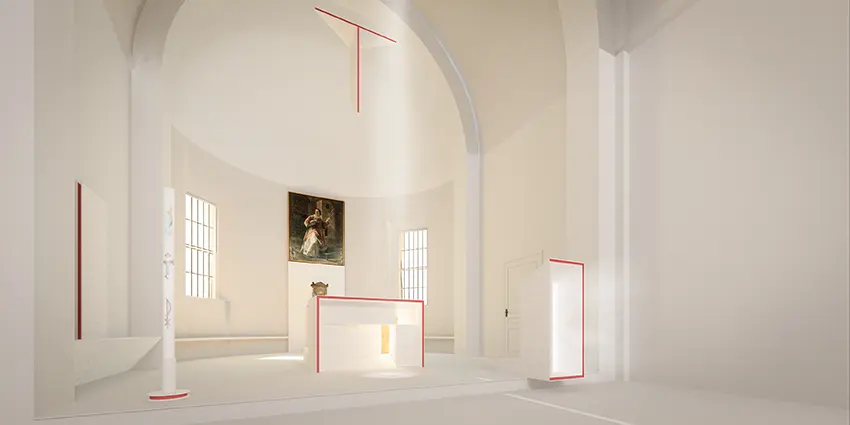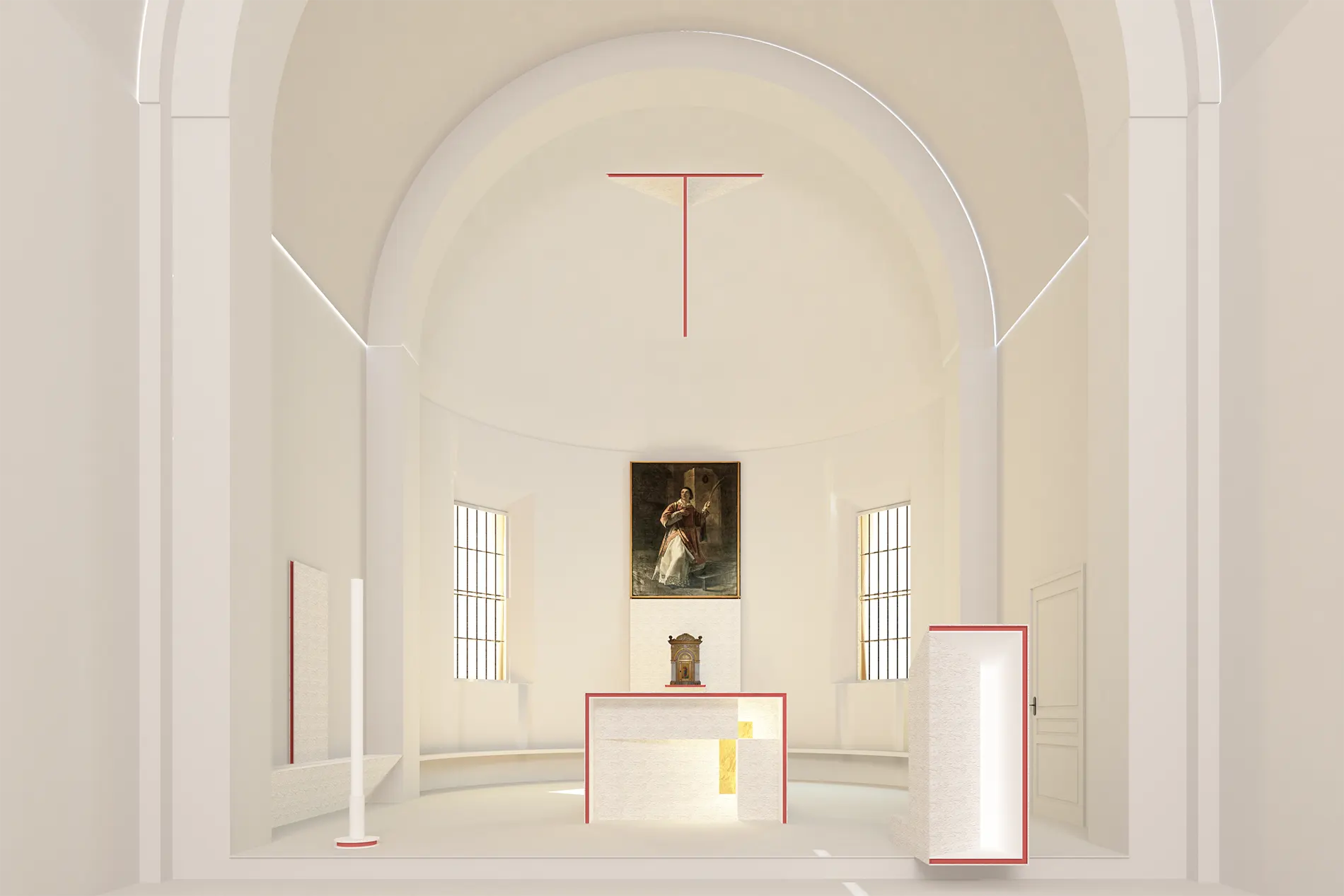

The project is a design reflection on the symbolic meaning of ritual elements and the character of the place. On the bank of the stream, the small country church, laid out on an east-west axis, has two gilded glass windows that pierce the apse from the side and flood the church with light on summer afternoons. The original terracotta floor and the bright interior create a delicately simple ambience. The theft of the original 19th-century tabernacle prompted an overall rethink of the liturgical site that is currently lacking and furnished with temporary solutions. The elements of the composition are envisioned as axons of weathered and hollowed wood, grey like the stone and aged to match the age of cross. The other colours present are red for the ribs of the folded planes, white for the interiors of the volumes and gold for the luminous hollows of the altar. On one side, the chair, a similar yet different bench, is a long side bench carved out of the thickness of the pilasters with a central vertical backrest for the celebrant. In the centre, the cross (which is currently missing) is jewelled and marks the central perspective of the church in a suspended position. Behind it, the backdrop – as if it were the former high altar – is the liturgical background, sized to match the picture of the saint, to which another historical tabernacle recovered in the meantime has been attached. On the other side, the ambo is an open sepulchre with a white interior that stands out against the red line of the edge. The altar is both table and Calvary, on which the gaze is centred. It is marked by the golden Chrismon cross. Like a tablecloth, three wooden planes define a trilithic frame painted in white. On the inside, the engraving of the cross is carved in negative by subtraction of volume until it reaches two gilded glass panes at depth – reclining head and abandoned body – that will shine in natural summer light.
Parrocchia di San Lorenzo
Parma, 2015